Thursday, November 15, 2012

"Style Wars" Reactions

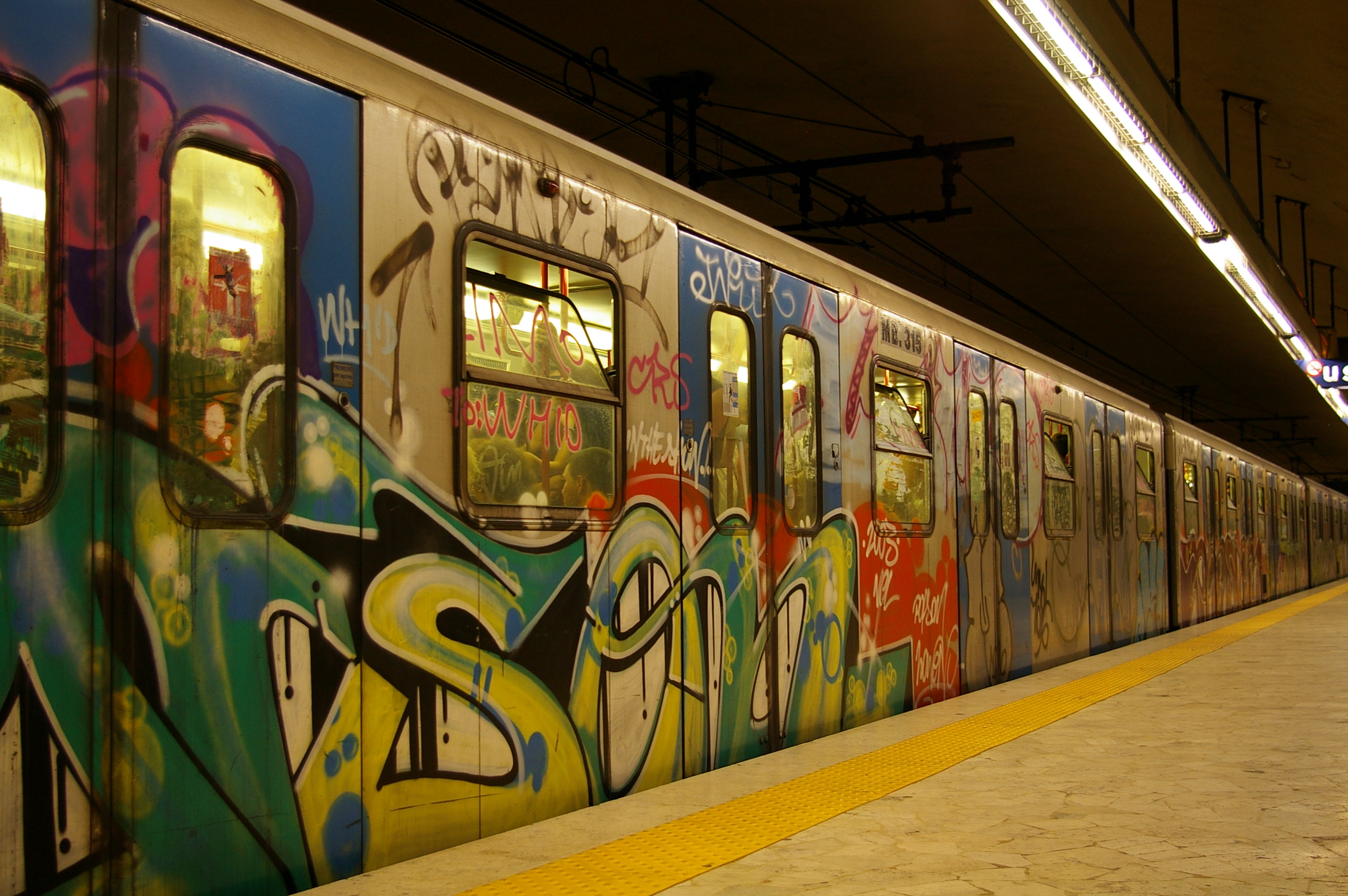
"Style Wars" was the source of a lot of controversy in my day today. As a self-proclaimed artist, I fully hold the position that graffiti ultimately does no one harm, and should therefore be left alone. I am not saying legalize it, but I just do not see the problem with it. In my view, there are three types of graffiti: murals, tags, and offensive language. Graffiti murals are some of the most expressive and colorful paintings done in modern art, and can be provocative, rebellious, and generally make things more beautiful and interesting. They can spice up a dirty street corner or an old rusty subway car, and I take umbrage with anyone who uses the word "defacing" when describing these. Tags, while maybe not being the prettiest or most interesting, are still a part of a subculture that most people ignore on a regular basis because they don't have much money and zilch opportunities but that should be heard. I think it is extremely elitist and pretentious to deprive people of a chance to make their mark on the world and maybe do something with their lives when some might not have much other chance to.  Offensive language and derogatory slurs may be put up along with tags and murals, but seriously, if this is the reason people want to get rid of graffiti then they might as well not stick their heads out of the door in the morning or listen to music or read the newspaper because nasty things are everywhere and censorship of an art form really wont change that much.

Not only is graffiti colorful and expressive, but it can also provide social commentary. The vigilante artist Banksy is considered one of the most prominent of these opinionated graffiti artists, who has murals around the world that depict things from memorable movie scenes to a young girl patting down an Israeli soldier. Banksy's identity is still unknown today, though he is apparently being sought by the authorities to pay for his uncensored street art. This is graffiti like any other, in fact it may even be uglier than the murals put up by street artists on subways, but unlike the sometimes scribbly tags or distinctive murals which are associated with African American culture, these, having an obvious meaning to people outside of "the know" are generally met with more enthusiasm. I think that this attitude is rather stupid, because in a way it is prejudice: people automatically dislike what they do not understand. 
 Another example of this phenomenon is on the Berlin Wall: after 1989, what remained of the wall was decorated by local artists who visually commented on the political situation. One of the more famous of these murals include an enormous blue car crashing through the wall, symbolizing the destruction of the division of the city. This is a double-sided mural; the back end of the car is shown on the East Berlin side of the wall. Another depicts a mash of faces upside down and sideways, huddled together but very intricate and colorful. This mural stretches on and on, and is really an amazing piece.

My bedroom! Not quite done yet though.
 I love the idea of graffiti, and though I know that I will never be a part of that subculture or fully understand the reasons that they put their art up, the methods of doing it and the risks involved, simply because I was born very privileged, I still would love to put up a mural somewhere one day, just to support the idea of graffiti and maybe try and stop every attack that calls it "ugly" and "defacing public property." I had the exact same discussion with my parents that we had in class, and they took the more conservative view for once in their lives which completely surprised me. They even used the exact same phrase: "How would you like it if someone our an enormous mural on our house?" I said bring it, because I have already done one (halfway anyways) in my bedroom and I am itching to start another, so they better fear for our front porch in the middle of the night...


Image sources: 
subway: http://upload.wikimedia.org/wikipedia/commons/0/05/Rome_subway_graffiti.jpg
Banksy: http://www.toptenz.net/wp-content/uploads/2009/11/17banksyES_468x606.jpg
Berlin wall: http://farm6.static.flickr.com/5009/5343443481_63e7f0ef3f.jpg

Tuesday, November 13, 2012

Gunnar is one odd bloke

         Gunnar Kaufman: affectionate son and brother, gang member, basketball star, poet, messiah, how can one person embody so many personas? This is one character that it is almost impossible not to like throughout the novel, even after he inadvertently convinces hundreds of people to commit suicide and shows no remorse for doing so. But his voice, with varying tones from "pardon me old bean" to "whadda sunovabitch"who can switch from jocular to intellectual to "hood" and back again four times in one sentence, is entrancing. I do indeed believe that this voice is ultimately what leads him to be the radical revolutionary figure that he is in the final chapter. Because this guy really just does not think like your everyday person on the street.

         I mean first of all, he was raised by some stunningly unique characters: a mother who can stuff a condom up her nose at the dinner table and say "Ta-da!" (one of the more staying anecdotes) and a father who may be a little like Bledsoe in that he seems ashamed that he is black, and therefore spends his days arresting other black people and palling with the white officers, imitating their tactics of beating young black men without cause. And perhaps this upbringing, from his unique role in Santa Monica environment to a temporarily solitary existence in Hillside before befriending the ultimate hipster, Mr. Nicholas Scoby, and once again becoming an idol. Something about Gunnar, (and I suspect that it had something to do with the way he talked) drew everyone to him. Now, unlike most teenage males who with this amount of attention would have an ego big enough to have a house of its own, Gunnar seems almost ashamed of his popularity, like he did not think he deserved it. In class someone brought up the idea that this was because he did not have to work at basketball like he did for poetry: his actual passion. But I think Gunnar would have been known widely even without his mad hops. And I think that one of the reasons he was so uncomfortable with all of the constant attention on him was for the reason he freely admitted: "I really don't give a fuck." Sure, he has opinions, but most of them concern only his own feelings and actions. For a prophet-messiah-black Jesus-like character he sure is self absorbed. But again, that is part of his appeal. He doesn't directly tell anyone to do anything, he's merely spit-balling ideas for himself.

        One part of the novel that sort of epitomized Gunnar's facetious and lovable weirdness for me was that he actually accepted Yoshiko into his life. I seriously thought Psycho Loco was completely kidding in an initiation/older brother "We need to get you laid" kind of way, and then whaddaya know, he has gone and actually ordered and paid for a human being on the black market. Now of course we expect Gunnar to refuse her because he's not in love with her, it's immoral, blah blah blah. Or maybe he'll accept her, but never really talk to her and have her stay in the background. But once again he utterly stunned me when he falls for this "Hot Mama-San of the Orient" who reminds him of his mother and has an odd fascination with his butt.

      But the more weirdness that falls out of this guy's words and actions, the more I love him as character. He has a charisma that kind of makes him irresistibly likeable, and I think this is what leads him to his final uprising. Or is it a downfall? I mean, he probably is going to die...
Yes, I am going to go with downfall. Because his final speech left me with a lot of questions, and if I were black I'm not sure I'd be willing to just down some suspicious grape Kool-Aid without asking any further questions. (More on this later).

Thursday, November 1, 2012

Janie and The Color Purple

         Well I have no idea if any of you have ever read The Color Purple by Alice Walker, but she was the person who is quoted on the front of Their Eyes Were Watching God as saying "There is no book more important to me than this one." The funny thing is, I happened to be reading The Color Purple simultaneously and completely coincidentally. I was extremely enthralled at the odds. Anyway, reading both novels at the same time (though I haven't finished the Alice Walker yet) made me see some eerie similarities (also HUGE differences) between Celie and Janie. Their names are the first one because I kept getting them mixed up in my mind, but that is the most minor.

          Both Janie and Celie are exposed to difficult situations when they are very young (our age) but they handle their situations very differently. They are married off to people that they do not know well very suddenly, and for the good of other people: Janie's Nanny's peace of mind, and in Celie's case, to keep Mr. ------- from her young, smart, and beautiful sister Nettie. But while Logan Killicks and Mr. ------- react to their new wives similarly (a general lack of appreciation, though Mr. ------ goes much farther down this road than Killicks ever did--he also surpasses Joe Starks), Janie shows much more obvious strength and independence that Celie does initially. She walks out on Killicks because she knows what she wants. Celie, meanwhile, is stubborn and selfless, but her fiery streak takes more prodding to activate than Janie's. She was determinately placid for most of the novel (of what I have read so far) until she found all of Nettie's letters that Mr. ------ had been keeping from her to convince her that Nettie was dead. After a few death threats she was calmed temporarily by Shug, the only person besides Nettie that she ever loved, whereas if Janie were in the same situation I am not sure she would have been calmed. I think that this varying aspect of their personalities comes from their polar childhoods. Janie, raised by her Nanny and a companion to white children, was allowed to daydream and have an actual childhood, while Celie meanwhile was the matriarch of her large family for most of her childhood in addition to dealing with her sexually abusive father, whose actions suppressed her spirit for the longest time.

        A lot of what drives both of these characters is their need to be loved, and both find ways to make this happen, but the ways in which they go about it seem to embody their personalities. Janie, who has had man after her her entire life, had no issue finding someone to love her, but rather the right someone. Janie had to stick up for what she wanted when everyone around her mistrusted her judgment and her chosen partner, the much-younger Tea Cake. She had to fight to get what she wanted. Celie, on the other hand, had been told her entire life that she was ugly and stupid, once again took the more passive route and found love elsewhere than her marriage. Having heard stories of elusive and exotic Shug Avery, the love of Mr. -------'s life, she too was enamored with this figure, even when the wealthy singer showed her nothing contempt and hatred for stealing her man. Shug eventually did come to love Celie, her primary caretaker, and when they slept together Celie was genuinely happy for what was probably the first time in her life. She never submitted to others' idea that she was too ugly and stupid to be loved, and so she fought this notion her own way.

        I know that both of these characters are incredibly strong to survive what each went through and not be a vegetable, (Janie having to murder her husband; Celie being raped and impregnated by her father) but I still marvel at how different their strengths manifest. In a way, Celie is even stronger than Janie, because while Janie has some snap, Celie bore everything in silence. And the novel isn't even over yet.